What St. Bernadette Actually Wore
And what clothing reveals about her personality, virtue, and vocation.
Most saints are recognizable by the features of their clothing.
We are reminded of the universal call to holiness when we observe the garments of the saints because clothing is personal, rather intimate, and serves as a point of relatability because it is something so human. The garments of the saints are telling of their mission, virtue, vocation, and even their personality. The saints surrendered every aspect of their life to the Lord that even their garments proclaimed the Gospel, as Bernadette said, “God speaks in the depths of the person, without the noise of words.” The saints knew how to rest with the Lord and His goodness was magnified through every fiber of their being, which meant even their garments had the residue of their encounter with Christ.
What we know about Bernadette’s clothing
The more accurate descriptions we have of Bernadette come from the work, St. Bernadette Soubirous 1844-1879 by Abbé François Trochu who compiled her story based on the archives from her life and those eyewitnesses who knew her.
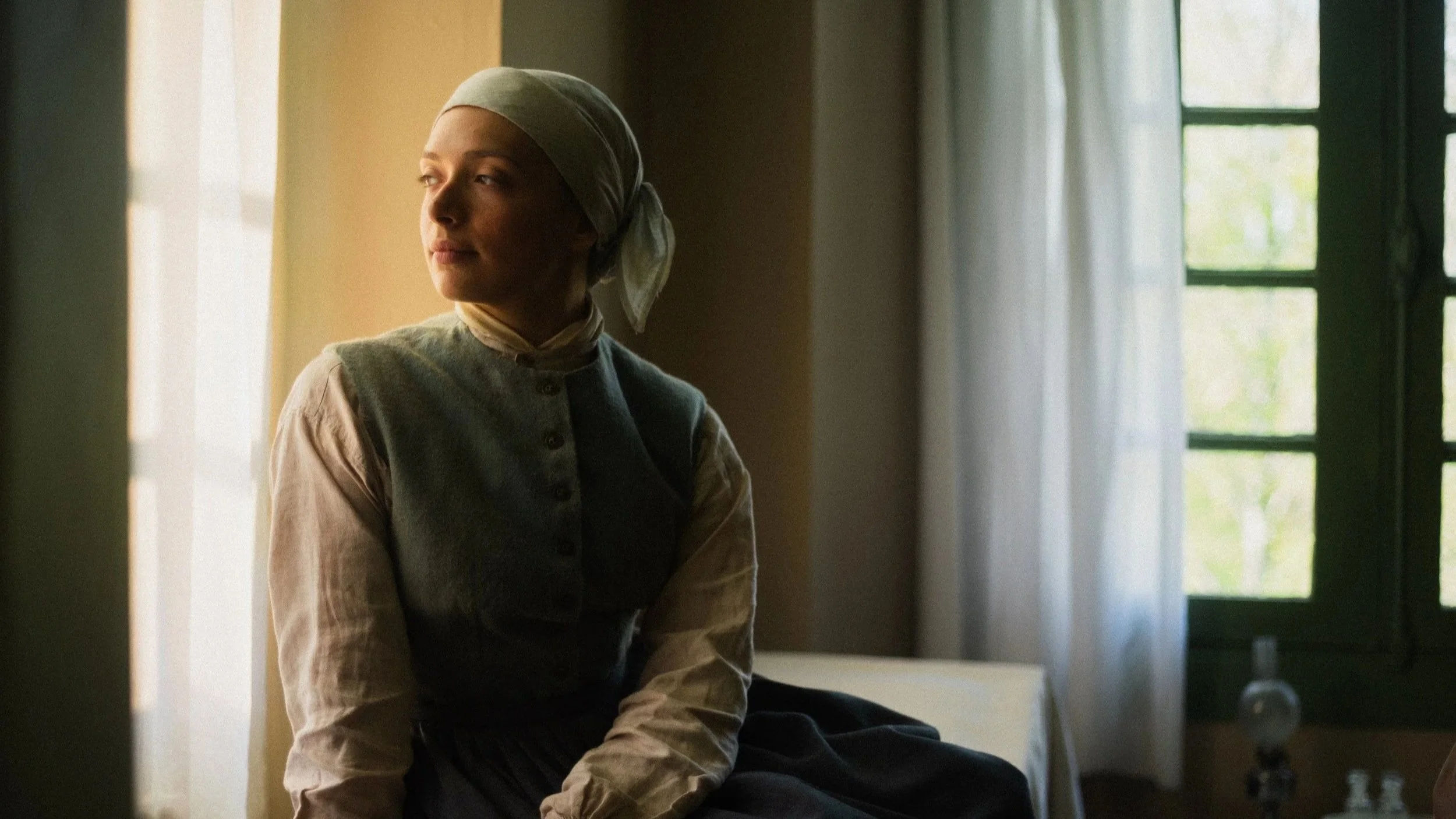
Many describe her selflessness and humility through her garments, as described by her neighbor, “She had her usual kerchief on her head, a shawl over her shoulders, her bare feet in sabots, and her dress reaching down to the ground”* as she carried her baby brother in hopes to find her mother in the nearby field. Often, she would be seen carrying her knitting work or a garment to mend so that she would always be caring for another through their clothing even when she was not with them.
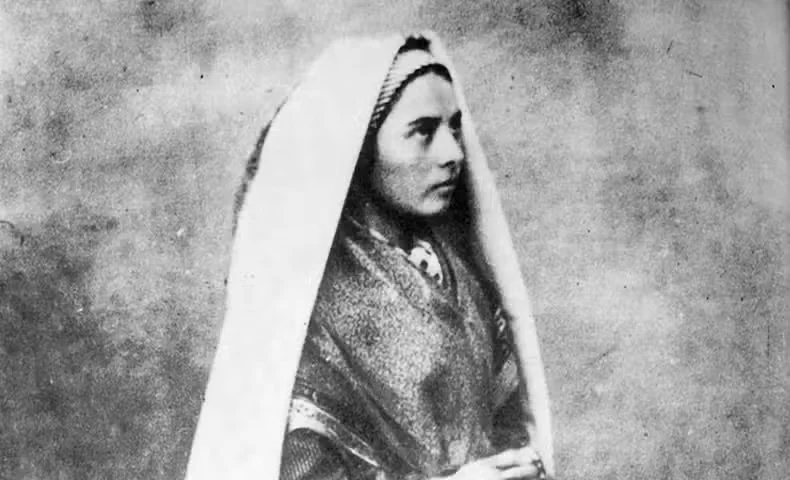
In one of the photos, Bernadette wears a white capelet which she wore during the apparitions and had been purchased from a used-clothes dealer. Nothing would go to waste that Bernadette received. A secondhand garment she treated as if it were made of the finest cloth. She is noted for taking careful care of her few garments:
“Her dress was plain and simple with an irreproachable neatness, indicative of self-respect and dignity amid poverty; that is all. Her headdress (a sort of madras with the patterns almost faded out from frequent washing) covered half her forehead and was bound tightly round her hair. Her neck, shoulders, waist, wrapped in folds of a material similar to her head-dress, recalled one of those busts roughed out by the sculptor’s chisel.”*
Her asthmatic suffering was quite literally worn on her sleeve as she was medically assigned a chest-protector to wear which unfortunately caused greater agony through its weight and discomfort.* The vest was meant to stimulate warmth and keep any necessary ointments close to the chest. Due to the weight of the quilted garment (probably looked like this one) and her difficulty breathing she often sat to the side as her friends played as she looked after their shawls and cloaks.*
Bernadette wore what was typical of her class when she attended the boarding school: “a straight skirt, a pinafore and a shawl fastened with a clasp across the breast. The colored kerchief gracefully wrapped round the head—as seen in photographs of the period—added to the innocent charm of Bernadette in her teens.”*
On one occasion she allowed herself to be dressed up, if one can even call it that, as “Sister Victorine surprised her ‘flouncing out her skirt to make it look like a crinoline’, and another day ‘inserting a sort of busk in her corset’. This was on the instigation of a companion. It was a fit of vanity that soon passed, leaving no trace. In short ‘it was a bit of childishness.’”* At the time, crinoline was typically woven from horsehair and used to add shape and volume to a dress. It is known as a stiff and resilient fabric that does not lose its shape. Bernadette later refusing to wear such a statement is an expression of her docility and obedience to the Lord, even in the face of being misunderstood by others.
She never sought to make a fuss about outward appearances such as on the occasion that her cousin, Jeanne Védère, took her to a photographer in Momères and made the note to Bernadette “M. Duffour, the photographer, wants me to make you look beautiful and dress you in other clothes.’ ‘If this gentleman does not find me handsome enough,’ said Bernadette, ‘leave me here. I refuse to add a single pin more.’”*
Bernadette cared for clothing, just not in the way you think
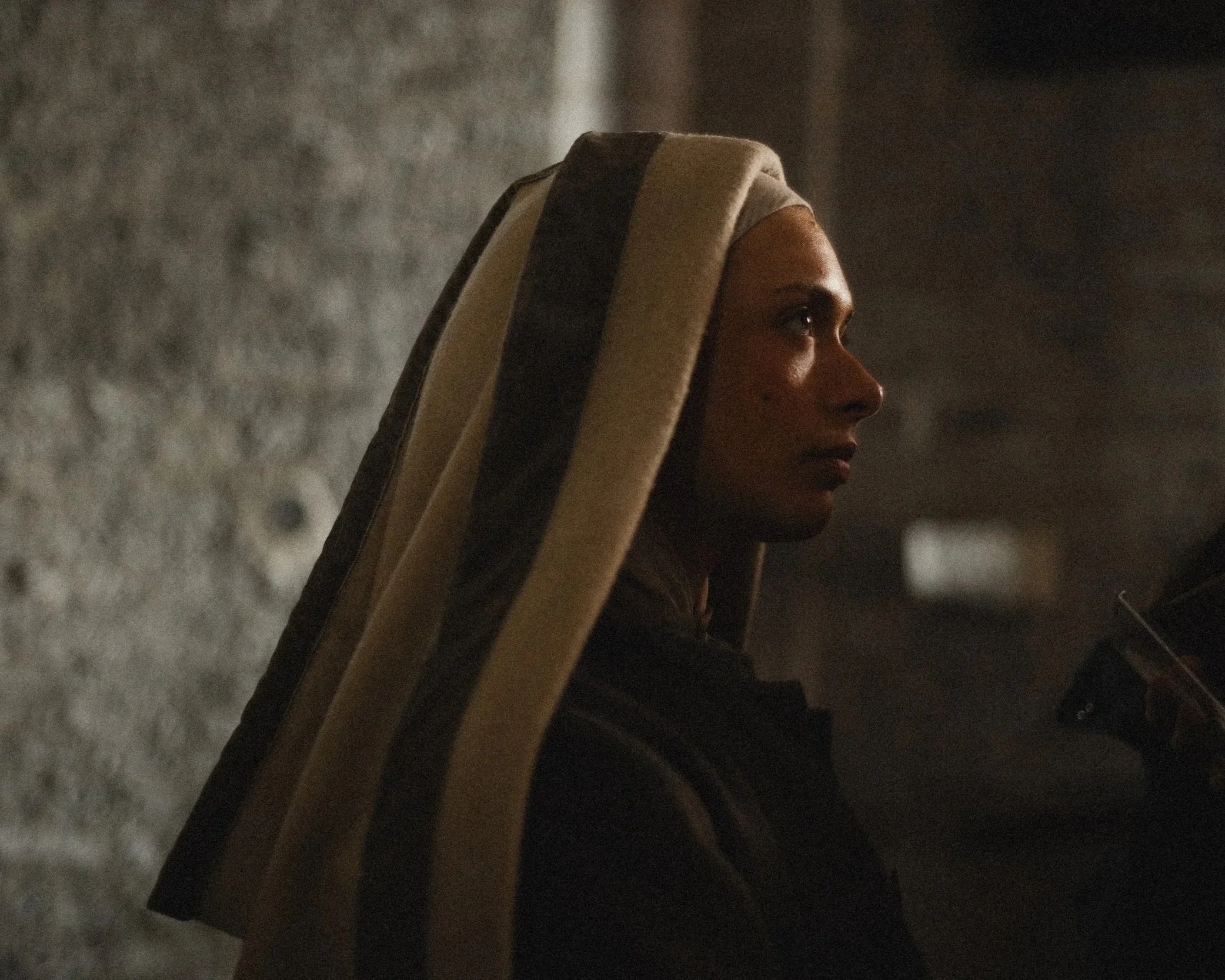
Many good intentioned sisters were excited about Bernadette’s interest in religious life, “Sisters of St. Vincent de Paul came to see her in Lourdes and tried the cornette on her. Bernadette would have none of it! Likewise the Sisters of the Cross sought to attract her into their midst: they tried their long headdress on her, but she said: ‘I don’t want that tunnel.’”* Bernadette would not stand for having elegant dresses or habits forced upon her. As someone who carefully washed and mended the few garments she owned, to make a drastic change in clothing would naturally coincide with her discernment of vocation.
When she decided to enter the Sisters of Notre Dame of Nevers, she was heartbroken to leave the grotto and her family behind but knew it was the Lord’s will. For her travels to the convent, she was reluctantly convinced by Mother Alexandrine to wear a dress that was a gift from a benefactress “a light blue dress with dark blue stripes.”* When she arrived, the Sisters from convents all over the town came to witness her entry, “They all felt a thrill when the little Lourdes girl appeared in her plain blue dress, with the Pyrenean foulard round her head.”*
Blue stripes have a long tradition of a connection to Our Lady’s protection over mariners. Despite Bernadette’s resistance, it is fitting her dress was blue stripes as a nod to the apparitions at the grotto. A foulard (a lightweight scarf) was typically made of twilled silk either plain or a simple pattern. Though it is likely Bernadette’s was made from a thinly woven wool as the textile was more common to her region.
Bernadette and her fellow postulants were nicknamed among the sisters as the “little bonnets” as they wore “the black tulle headband of monastic simplicity but trimmed with a double frill over the forehead and loosely hanging strings.”* Their black tulle headbands reflect their dying to self as they begin to adjust to life in the convent.
What the habit meant for Bernadette
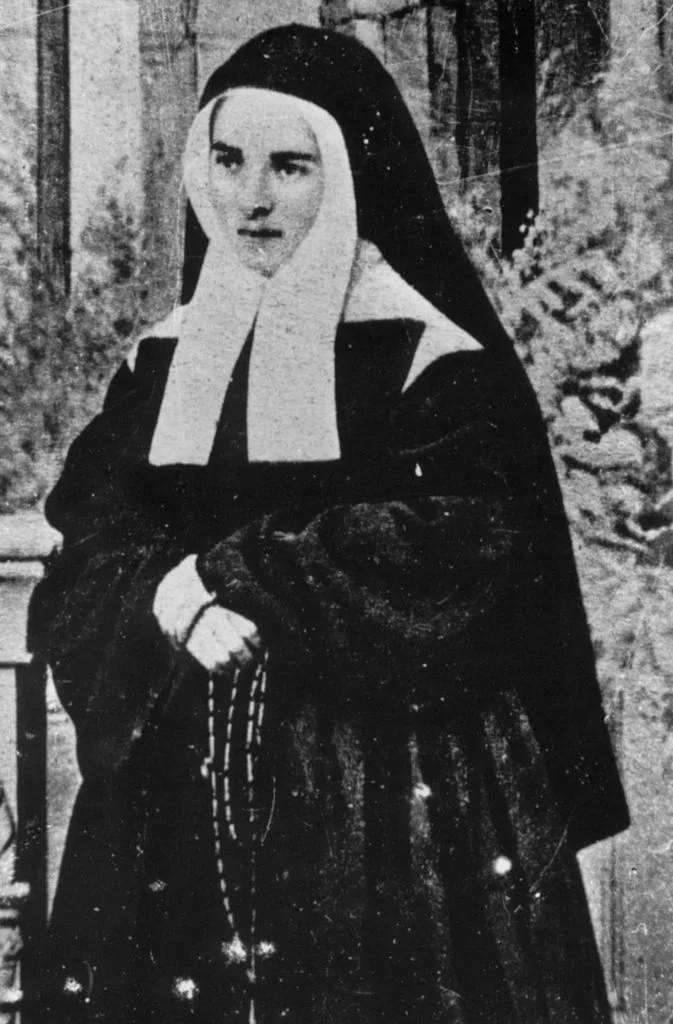
As she prepared for her clothing day, she asked a fellow postulant why she kept her eyes closed when receiving the habit and she told her to keep eyes wide-open.* We must recognize the profundity of the clothing day for Bernadette. This is often a climactic moment for any woman entering religious life, but especially for Bernadette as one who owned so few garments in her life. Considering the points in life when other sisters thrusted habits upon her or benefactors dressed her, she wanted to receive the novice’s veil with her eyes wide open, a recognition this was her free decision and choosing.
Despite the fact that Bernadette wore the same dress as all the other sisters, she was distinguished “by the mere arrangement of her veil and by her general appearance: the humble nun, who during the week was dressed only in old-darned clothes, never failed for all that to look, as was said of her, ‘as if she had just come out of a bandbox.’”* A bandbox was typically designated to gather fabric scraps for mending. We can imagine Bernadette’s habit being a bit mismatched with her patchwork. Both the 17th century expression of “bandbox” and modern-day expression reflect something of the personality of Bernadette as mentioned by the Merriam-Webster Dictionary:
“In the 17th century, the word ‘band’ was sometimes used for ruffs, the large round collars of pleated muslin or linen worn by men and women of the time period, and the bandbox was invented for holding such bands. The flimsy cardboard structure of the box inspired people to start using its name for any flimsy object, especially a small and insubstantial one. But people also contemplated the neat, sharp appearance of ruffs just taken from a bandbox and began using the word in a complimentary way in phrases such as ‘she looked as if she came out of a bandbox.’ Today, ‘bandbox’ can also be used as an adjective meaning ‘exquisitely neat, clean, or ordered,’ as in ‘bandbox military officers.’”
Bernadette recognized her fragility, from her poor health and slowness in academic learning, to her absolute dependency on Christ’s grace as she served the sick in the infirmary. Additionally, she was quite ordered and did not give herself any slack. She made sure her garments were mended and cleaned just as she was always gracious to receive correction as she submitted herself to Christ through her Sisters of Notre Dame.
As you realize the humanity of Bernadette through her garments, may you be encouraged to seek Christ in the ordinary. Invite the Holy Spirit to sanctify each moment of your day from the most mundane tasks to those of greater difficulty.
*All quotes and references are from Abbé François Trochu, St. Bernadette Soubirous 1844-1879 unless otherwise noted